

How MBTI Can Help You Develop as an Adult
And navigate an increasingly complex world with more space.

Most of us spend our lives trying to be “better.”
We learn new productivity hacks, pick up new skills, and try to manage our stress. But have you ever felt like you were doing all the right things and still feel like you’re running in place?
In my two decades of training and coaching (and working on myself through many falls and fails), I’ve found that most people aren’t suffering from a lack of information or skills. They’re suffering from a lack of space.
Who This Article is For
People who want the space to lead, partner and live with a sense of wholeness
People who want to live without impending burnout and purposelessness
People interested in how tools like MBTI and adult development theory can help
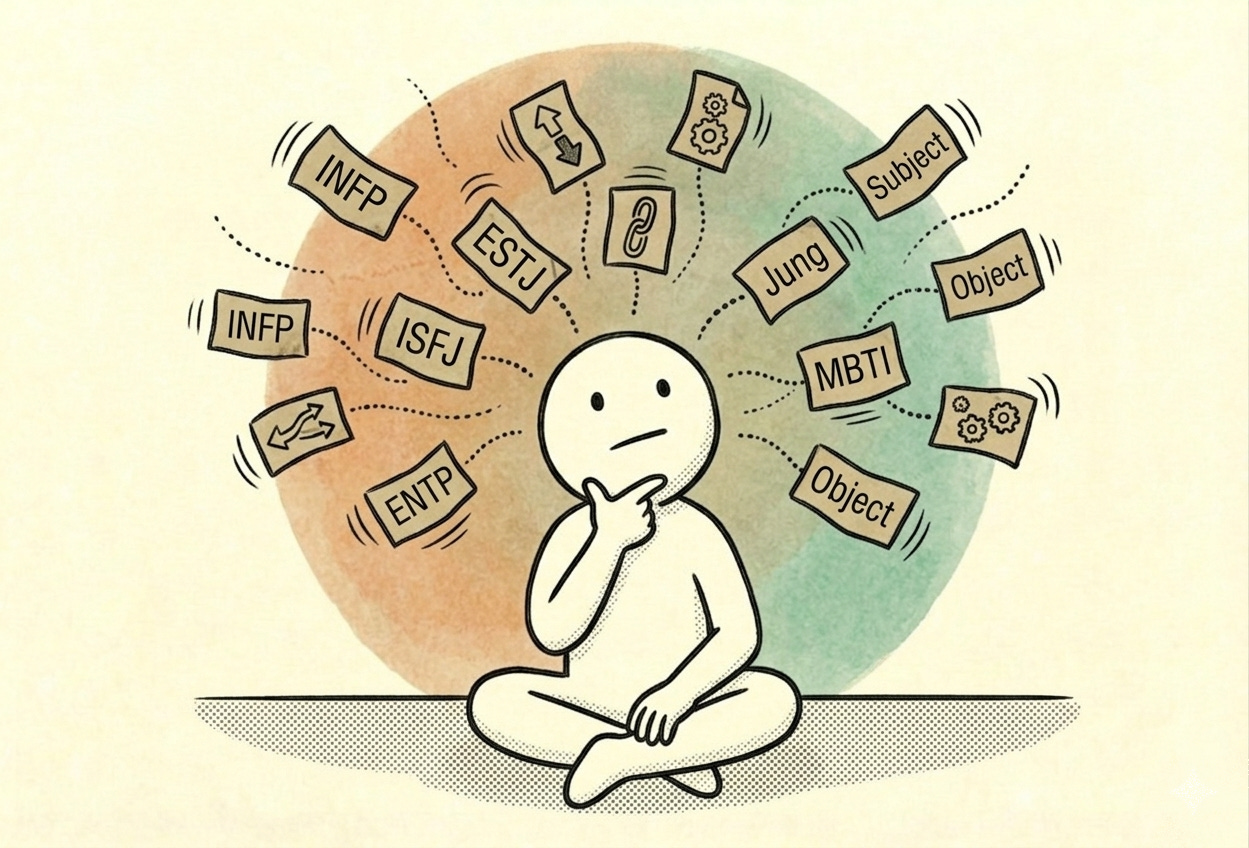
There Is No One Size Fits All Theory
There is no shortage of theories, disciplines, or schools of thought designed to help humans grow. From ancient philosophy to modern neuroscience, each offers a different piece of the puzzle. I believe that “mixing and matching” these disciplines is not just okay, it’s necessary.
What resonates with us in our 20s often feels insufficient in our 40s. Depending on your phase of life, your career demands, or your personal circumstances, it’s okay to flexibly lean into what resonates most with you.
In this series, I want to share a unique way of looking at growth by synthesizing two well-known frameworks for human understanding: Carl Jung’s theory of individuation and Robert Kegan’s constructive-developmental theory.
Take the free, 2-minute Mental OS Assessment below to identify where you may currently be developmentally, and explore ways to develop further as an adult.
Lens 1: Jungian Individuation / MBTI
Carl Jung suggested that there are two major acts in our personality development.
In the first half of life, we focus on survival and success. We try to master our natural strengths. Note: This is where MBTI can be a helpful tool. It helps package Jung’s theory in a practical and digestible way, and makes it much easier to identify what our personality strengths are, as defined by Jung.
For example, if you are an INTP, internal logic is a great strength; if you are an ENFJ, you likely thrive at building connections.
But while this “strength-building” phase is vital, there is more to it.
Jung argued that in the second half of life, through a process he called Individuation, we begin to open up the “neglected strands” of our personality to reach a state of wholeness.
It’s about integrating the parts of ourselves we’ve ignored so that we can become the individual we truly are, not one defined by the “herd.”
Lens 2: Adult Development Theory
Robert Kegan’s decades of work on adult development theory (specifically something called constructive developmental theory) offers us another lens, and one that has fascinating overlaps with Jung’s theories.
According to Kegan and many other seminal figures in the field, a core process in development is the Subject-Object shift.
Subject: The assumptions, lenses, and habits that “hold us.” We are fused with them and cannot see them; therefore, they control us.
Object: The things we can step back from, reflect upon, and take responsibility for. When we “hold it” rather than “be held by it”, we have the choice to use it or not.
Development is the process of moving more of our experience from Subject to Object. It’s the difference between being a character in a script, and being the architect holding the pen.
(For a more detailed summary that includes descriptions of the stages of development, read: What is Adult Development Theory?)
The Series: It’s about getting unstuck.
My hope for this series is to offer specific, practical insights for each of the 16 MBTI types. By looking at your “Type” through a developmental lens, we can identify your predictable “Stuck Points”—the places where your natural strengths can actually blind you from other areas within you that are waiting to be developed.
Whether you are looking to get unstuck in your career, move beyond burnout, or find a deeper sense of purpose, this series is designed to help you perform a structural audit of your own mind.
Please note.
I have received MBTI Certification and am a Certified Subject-Object interviewer, but I’m not a university professor or clinician. This series is not an academic paper, nor clinical or psychological advice.
The theories we are dealing with are intensely complex, and I will be deliberately simplifying them. To the deep fans of Jung or Constructive Developmental Theory: you will notice missing layers and nuances.
This series is designed to offer perspectives and clues for us to navigate life with more space.
What to Expect in Upcoming Articles
In the articles that follow, we will deconstruct specific personality types to reveal the hidden architecture of their success and their stuckness. Each article will cover:
Your Early Success Strategy: How your type mastered the first half of life.
The Mid-Life Wall: What happens when your greatest strength becomes a cage.
The Renovation: How to develop your unused functions to unlock higher stages of adult development.
Practical Next Steps: Concrete experiments to help you break your own ceiling.
Finally
I have no fixed order of MBTI types I’ll write about. So write in the comments any you’d like me to prioritize :)
Thanks for reading.
Until next time,
TK
It’s okay if you don’t like MBTI or adult development theory. It’s okay if you don’t know much about it. I believe there are still insight you can gain from them. These articles touch on that:


And here’s the first personality exploration:

Jung and Kegan are describing a process of uncovering something that was already there, the neglected strands, the subject becoming object.
BaZi Astrology (Omnigram) takes a different angle: it maps the constitutional layer from birth data before any of the first-half-of-life strategy forms. The 'stuck points' you're describing often show up in the chart as elemental imbalances, too much of one force, not enough of another, or a clash between two powers.
Curious whether you'd ever consider layering a birth-data system alongside the developmental framework, it might reveal why different types hit their mid-life wall at different times.
Looking forward to reading more! My vote is for INFJ please 😊