

Are You Pulled By Expectations?
How 58% of adults are caught in the transition between being defined by others and authoring themselves.

It’s 3:30 PM on a Friday. You’re looking forward to spending time at home. If a colleague asks you to stay late today, you’re ready to say “no.” You feel firm. You feel ready.
Then, the Slack message pings.
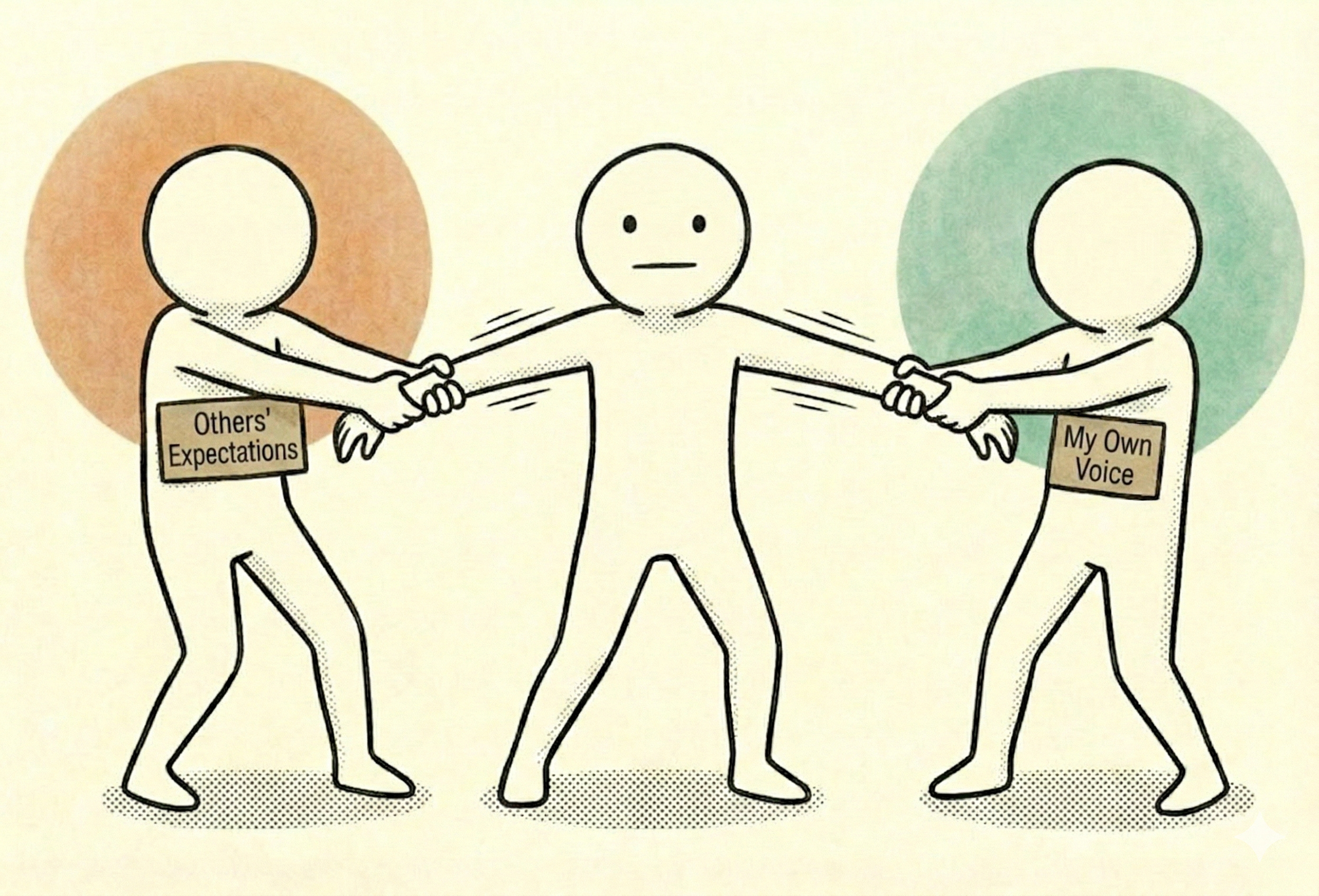
As soon as you read their request- “I’m in a huge bind, and I really trust your perspective”- your stomach tightens. The “firmness” evaporates. Suddenly, your evening at home feel “selfish.” You aren’t just feeling a colleague’s disappointment; you are experiencing it as a threat to your own sense of being a “good person.”
What are you going to say?
For the majority of adults, this internal ‘tug’ is our daily bread.
Why does this happen? Is there a way to finally find some peace with this? Let’s look at this from the perspective of adult development theory.
The Shift to Psychological Sovereignty
In adult development theory (or constructive developmental theory), what is called the Socialized Mind is when our identity, values and decision making processes are closely tied to the important people in our lives.
Think of your mind as being run by a “Board of Directors.” When we are in the Socialized Mind, the board is made up of your boss, your partner, your peers, and your culture. You look to them for your standards of “rightness.”
Eventually we learn to become the “Chair of the Board”, where we take the voices of our other board members into consideration, but ultimately we are secure in our own decision. This way of operating characterizes what is called the Self-Authored Mind.
Work by Robert Kegan and other researchers in the field of adult development theory show that most adults are either in the Socialized Mind, or are in transition to the Self-Authored (roughly 58% of adults).
That stressful ‘tug’ we were talking about? It’s often an expression of the confusing transition of our psychological architecture.
An Evolutionary Breakthrough
I do want to be clear, that the Socialized Mind is by no means a weakness. In fact, it’s an evolutionary breakthrough and something to be celebrated (and probably something every parent wants their kids to eventually be able to do).
It is a sign we have shifted from a “tit-for-tat” transactional nature of communication, and started asking “How do we fit together?” rather than only “What’s in it for me?”
It’s a sign we’ve moved beyond a rigid tendency to think in “black-and-white”, “right or wrong”, “either/or”, to something more nuanced that encompasses multiple perspectives.
It’s a sign we can really put ourselves in the shoes of others. It’s the reason we are a loyal friend, a reliable teammate, and someone who can follow rules and embody values because we understand it, not ‘abiding’ just to avoid punishment.
It is a beautiful, necessary expansion of the human heart that has allowed us to have the success we have today in our work and relationships.
The ‘Tug’ Between Your Voice and Theirs
If you feel the ‘tug’ of wanting to be liked by your people, and wanting to be assertive in your position- that isn’t a sign of weakness- it’s a sign of evolutionary transition.
You are beginning to realize that you don’t have to meet every expectation, but the “Likeability Tax” is still high. For example when Boss A and Boss B want different things, you feel internally fractured. Because you are still “in sync” with both, it feels like you need to be two different people at once.
Fortunately our minds evolve forward and we eventually find more peace in navigating situations like this.
Three Questions for the Shift
Here are some reflection questions to support the evolution:
The No-Validation Check: If you received zero external validation or “Gold Stars” for your work this entire month, what specific parts of your day would still feel deeply meaningful to you?
The Permission Habit: Are you currently waiting for an “authority” to give you permission to own your career, or are you feeling ready to seize the psychological pen?
The In-Sync Diagnostic: Do you feel “out of balance” because you’re failing at your tasks, or because you’re finally outgrowing the need to be “suitable” for everyone else?
Your Developmental Snapshot
“Stuckness” is just the sound of an old map failing to describe a new territory. You aren’t failing; you are incubating.
If you’re curious what your current map may look like, feel free to take the free, 2-minute Developmental Assessment below. It will give you a snapshot of how you may currently be operating, and suggest potential ways forward (and some more details on adult development theory, and the work I do).
Thanks for reading. If you’d like to explore more on adult development theory, here are a few articles to entertain your brain:


Until next time.
-TK
That statistic hits hard.